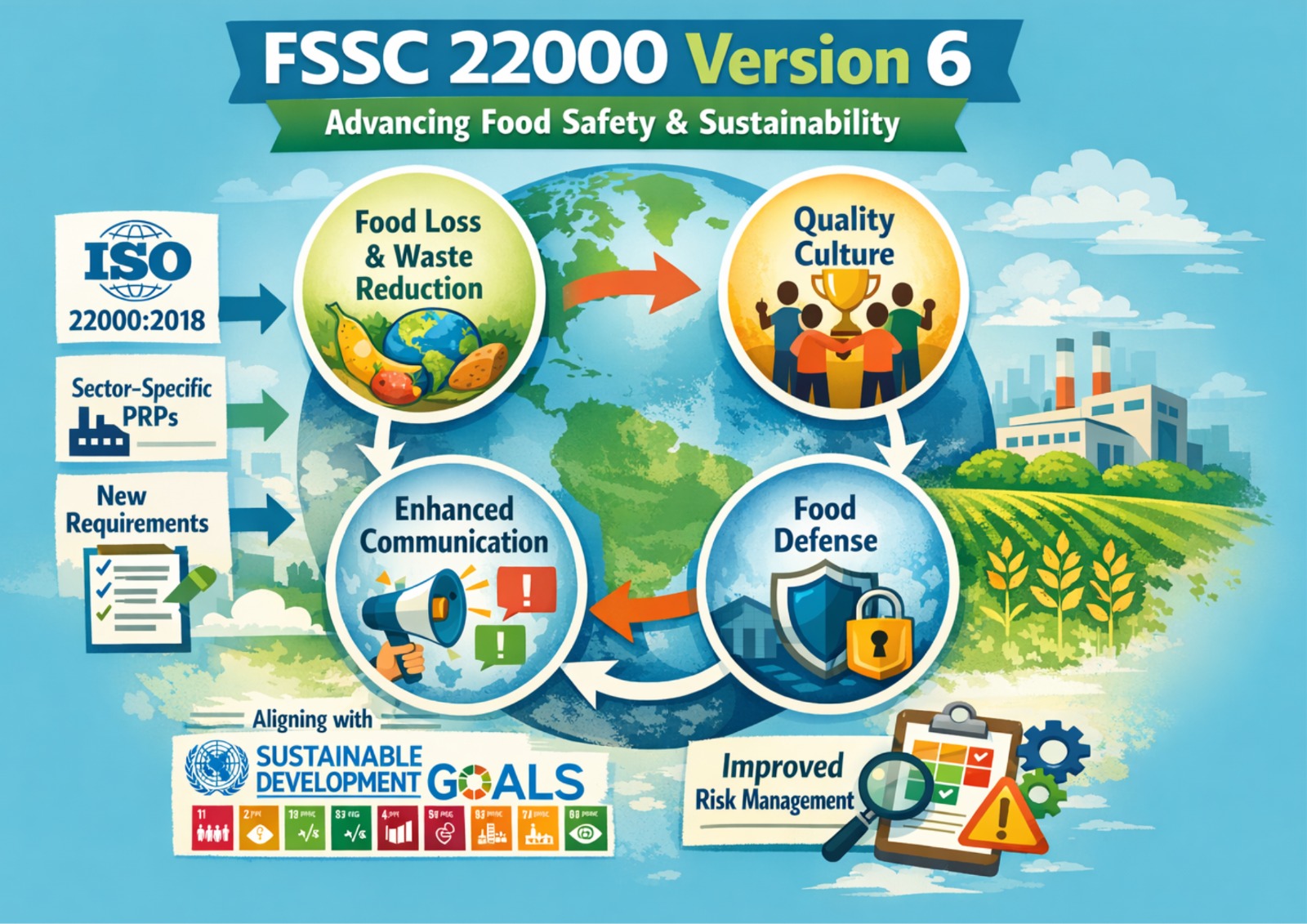
Food safety has become a global priority, driven by increasing consumer awareness, regulatory requirements, and complex supply chains. To address these challenges, the FSSC 22000 (Food Safety System Certification) scheme provides a robust framework for managing food safety risks across the entire food chain. In April 2023, the Foundation FSSC released FSSC 22000 Version 6, introducing important updates to strengthen food safety culture, supply chain control, and risk management.
This blog provides a clear, clause-by-clause overview of FSSC 22000 Version 6 clause, helping organizations understand the structure, key requirements, and changes compared to earlier versions.
FSSC 22000 Version 6
FSSC 22000 Version 6 is a GFSI-recognized food safety certification scheme applicable to food manufacturing, packaging, storage, distribution, animal feed, and food service organizations. It is built on three core components:
- ISO 22000:2018 – Food Safety Management System
- Sector-specific Prerequisite Programs (PRPs) (ISO/TS 22002 series)
- Additional FSSC Requirements
Version 6 enhances the scheme by focusing on:
- Food safety culture
- Quality management integration
- Fraud and defense strengthening
- Supply chain transparency
- Sustainability and regulatory compliance
Structure of FSSC 22000 Version 6 Clauses
FSSC 22000 Version 6 follows the ISO High-Level Structure (HLS), making it compatible with other ISO standards such as ISO 9001 and ISO 14001.
The clauses are structured as follows:
- ISO 22000 clauses (Clauses 4 to 10)
- Sector-specific PRPs
- FSSC additional requirements
Clause 4: Context of the Organization
Clause 4 focuses on understanding the organization and its operating environment.
Key Requirements:
- Identify internal and external issues affecting food safety
- Understand needs and expectations of interested parties (customers, regulators, suppliers, consumers)
- Define the scope of the Food Safety Management System (FSMS)
- Establish and maintain FSMS processes
Version 6 Focus:
Organizations must now consider food safety culture, supply chain risks, and regulatory changes more explicitly when defining context.
Clause 5: Leadership
Leadership commitment is critical in FSSC 22000 Version 6.
Key Requirements:
- Demonstrate top management commitment
- Establish a food safety policy
- Assign roles, responsibilities, and authorities
- Promote a strong food safety culture
Version 6 Enhancement:
Food safety culture is emphasized through:
- Clear communication of food safety values
- Employee engagement and awareness
- Accountability at all levels of the organization
Clause 6: Planning
Clause 6 addresses risk-based thinking and planning actions to achieve FSMS objectives.
Key Requirements:
- Identify food safety risks and opportunities
- Set measurable food safety objectives
- Plan changes to the FSMS in a controlled manner
Version 6 Emphasis:
Risk management must now consider:
- Supply chain vulnerabilities
- Emerging food safety threats
- Fraud and intentional contamination risks
Clause 7: Support
Clause 7 ensures the organization has adequate resources to maintain food safety.
Key Requirements:
- Provide competent personnel
- Maintain infrastructure and work environment
- Control documented information
- Ensure effective communication (internal and external)
Version 6 Additions:
- Stronger emphasis on competency management
- Digital document control and traceability
- Awareness training aligned with food safety culture
Clause 8: Operation
Clause 8 is the core of FSSC 22000, covering food safety operations.
Key Requirements:
- Operational planning and control
- Prerequisite Programs (PRPs)
- Hazard analysis and control measures
- Traceability systems
- Control of nonconforming products
- Emergency preparedness
Version 6 Strengthening:
- Improved supplier approval and monitoring
- Enhanced allergen management
- Stronger traceability and recall systems
- Integration of food fraud and food defense plans into operations
Clause 9: Performance Evaluation
Clause 9 ensures the FSMS is monitored and evaluated for effectiveness.
Key Requirements:
- Monitoring, measurement, analysis, and evaluation
- Internal audits
- Management review
Version 6 Focus:
Management reviews must now consider:
- Food safety culture performance
- Supplier performance trends
- Effectiveness of fraud and defense controls
- Regulatory compliance status
Clause 10: Improvement
Clause 10 focuses on continuous improvement and corrective actions.
Key Requirements:
- Manage nonconformities and corrective actions
- Continually improve FSMS effectiveness
- Use audit findings and performance data for improvement
Version 6 Alignment:
Organizations are expected to:
- Demonstrate proactive improvements
- Address root causes, not just symptoms
- Improve food safety maturity over time
Sector-Specific Prerequisite Programs (PRPs)
In addition to ISO 22000 clauses, FSSC 22000 Version 6 requires compliance with sector-specific prerequisite programs, such as:
- ISO/TS 22002-1 – Food manufacturing
- ISO/TS 22002-4 – Food packaging
- ISO/TS 22002-6 – Feed production
Prerequisite programs cover
- Facility hygiene
- Equipment maintenance
- Pest control
- Cleaning and sanitation
- Waste management
- Personnel hygiene
Version 6 requires stronger documentation and validation of Prerequisite programs.
Key Changes from FSSC 22000 Version 5.1 to Version 6:
| Area | Version 6 Enhancement |
| Food Safety Culture | Stronger, mandatory focus |
| Quality Integration | New requirement |
| Supply Chain | Increased transparency |
| Food Fraud & Defense | More robust controls |
| Regulatory Focus | Enhanced compliance expectations |
Benefits of Implementing FSSC 22000 Version 6 Clause:
Organizations certified to FSSC 22000 Version 6 clause benefit from:
- Enhanced food safety assurance
- Global market acceptance
- Improved brand reputation
- Reduced food safety incidents
- Stronger customer and regulator confidence
Understanding and implementing the FSSC 22000 Version 6 clauses is essential for organizations seeking certification, recertification, or system improvement. With proper planning, training, and continuous improvement, FSSC 22000 Version 6 becomes a powerful tool for ensuring safe, high-quality food across the global supply chain.
Leave a Reply